Welcome to 2026! We are still pumped after all the chaos and excitement that the events of last year brought us. As you already know, we are planning to open the year strong - World Expansion IV with Open Campaign mode and an all-new ice biome, which we have decided to call Cryo Fields. We have already completed a significant amount of work, as you can see in our Survival streams on Twitch. With such a head start, you should have the new content in your hands within a very reasonable timeframe. Still, we have learned not to make promises, so no ETA just yet.
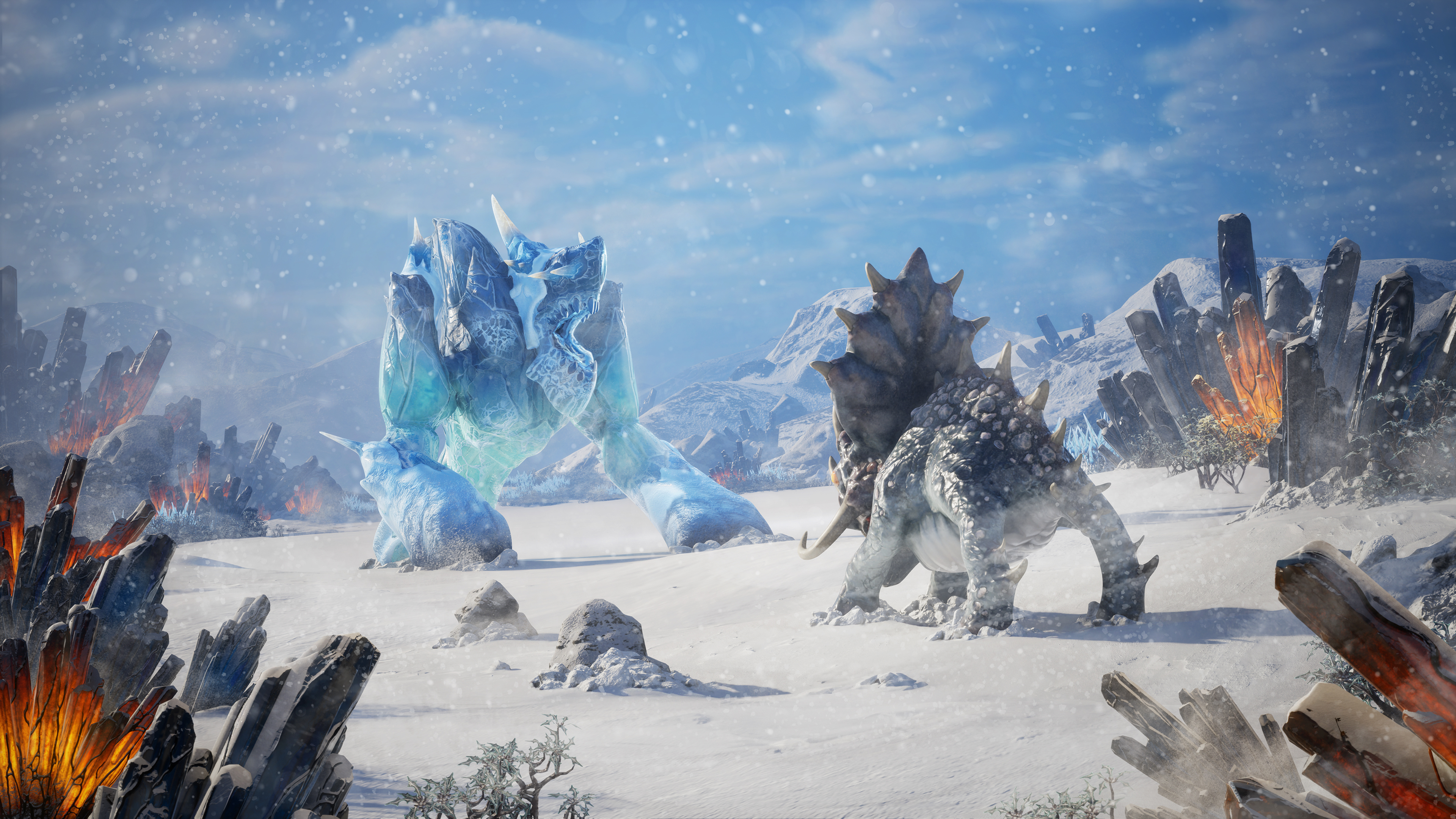
One of the new loading screens for the Cryo Fields biome. Just a little sneak peek of what's coming!
In fact, we want to kick things off with an article on what we learned over the past year and how we will apply the lessons from 2025 to our development practices in 2026 and beyond. This article is a supplement to our 2025 in Review article. We hope you enjoy this reflection before we fully dive into what’s coming to The Riftbreaker this year.
Here's a short video if you prefer the TL;DR version.
We never thought we would live the gangster film cliché of “I’ll do you a favor, but I’ll come back for payment later,” but it happened multiple times during co-op development. During the beta period, we focused on Survival Mode because it allowed us to test and iterate on the core gameplay mechanics in a relatively simple environment. When we started testing the co-op campaign, however, we noticed a pattern. All the basic game mechanics worked flawlessly, but whenever we encountered any custom elements that were only present in the Campaign, things would start to break. This is not surprising on its own - we didn’t test these solutions in beta, so, logically, bugs would follow. Still, we were surprised by the sheer number of one-time solutions that were good enough for single-player purposes, but came back to bite us now.

We wanted this cutie to be the centerpiece of the combat scene, so we decided to do a little bit of camera manipulation. Two years later, this decision generated some problems.
Let’s take the boss fight in the Into the Dark expansion as an example. When the player enters the boss arena, we detach the camera from Mr. Riggs and move it to a central point overseeing the battlefield. This is the only place in the game where this happens. We achieved this effect using a very simple and dirty trick. The camera movement was baked into the mission's logic flow. This logic block instructed the game to take control of the player’s camera and move it to a custom point we placed over the arena. This worked fine for single-player, because there was only one camera to take over. With multiple players present, things went very wrong. Errors included, but were not limited to:
This example is just the tip of the iceberg. These ‘mistakes’ often stem from the fact that we didn’t want to take away programmers’ attention from their other tasks. If we can ‘hack’ a solution for a problem, this will save time for everyone. Only after adding co-op did it become clear that we had merely delayed our payment. It also often came with additional interest, since some of our custom solutions were ‘baked into’ save files and would cause incompatibility, increasing the complexity of the problem by a factor of 10. Fixing all the individual custom solutions in the Campaign took a very long time. It couldn’t have been avoided, since the game was SP only for the longest time. However, we now know what to do going forward.

Since you're a kid you're being told to be independent and solve problems on your own. However, asking for insight from others may reveal problems that you wouldn't have thought of and save you trouble later. APES TOGETHER STRONG!
Conclusion: Don’t be afraid to ask for help. Think about your tasks in both single- and multiplayer contexts.
Rushing headfirst into overwhelming enemy forces and using your mech’s death explosion was one of the first tactics that players discovered, way back in the days of The Riftbreaker’s pre-alpha test. We weren’t particularly happy with that, as it’s not how we envisioned combat to play out, but if you were okay with it, we were too. It was a single-player experience, after all, and you should be able to play however you wanted. Things took a bit of a turn when players started doing it in co-op. One exploding mech is quite a lot of firepower, but it comes at a cost - you are out of action for a moment, and it is often enough for the enemies to deal at least some damage. Four mechs repeatedly exploding had the potential to neutralize the entire enemy's firepower without breaking a sweat. We decided to step in.

We didn't want to take away your ability to run head-first into the enemy horde. We simply wanted to limit its effectiveness a little.
First, we tried the carrot - we offered a powerful boost as a reward for reviving players who fell in battle. We reasoned that players would prefer to win a fight with standard firepower, so we offered an additional incentive to do so. It worked pretty well, but some people still preferred the brutal efficiency of charging forward and exploding in Canoptrix’s faces. If the carrot wasn’t enough, stick it is then. We designed a new system, called the Death Skulls. We thoroughly explained it in an article (you can read it here), discussed the implications with our community members, and began testing it on the game's Beta version. It was crucial to us to communicate that we did not want to punish you for playing the game. We tried to discourage an unwanted behavior pattern and to make clear that this system is entirely avoidable.
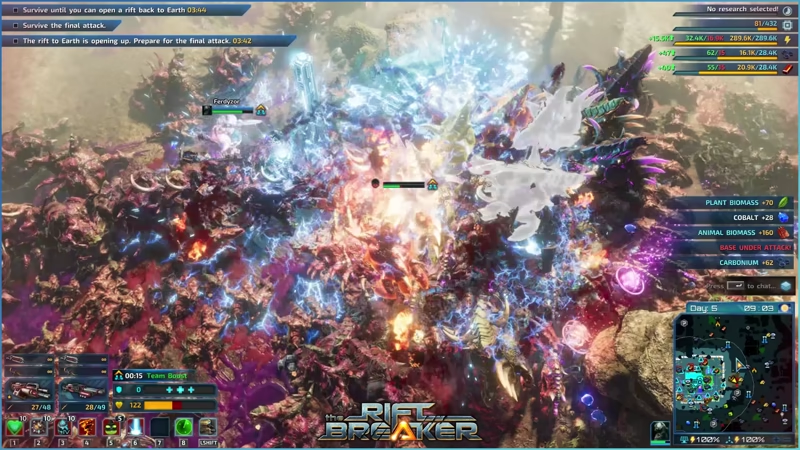
The new system requires a more tactical approach to combat and brings back the importance of base defenses, without decreasing the mech's power outright.
We were hesitant to publish these changes, as we feared you wouldn’t be happy with such fundamental changes to game mechanics. However, thanks to our clear explanations, our willingness to listen to feedback, and our ensuring the system did not interfere with regular gameplay (and the fact that this system can be turned off in gameplay settings), you welcomed the change and adapted quickly.
Conclusion: Be clear, transparent, and open to discussion. You’re designing the game for the people - let them know you are not against them.
The beta version of The Riftbreaker Co-Op encountered significant growing pains. We released updates regularly, carefully explaining our rationale and leaving room for discussion. The goal was always clear to us: to act in the best interests of players and demonstrate that we are open to change if any problems arise. Unfortunately, some people viewed our updates and transparent communication style as a sign of weakness. They thought we only did these write-ups to cover our backs in case we inevitably fail to deliver the promised co-op mode. We heard their concerns. They were not unfounded and likely the result of frustration after waiting a long time for co-op. However, we knew that when the update arrived, they would change their minds.

We wanted to include special, more powerful creature versions in the game since the very beginning. The 2.0 update seemed like a good time to do so, and you helped us bring them to life!
One of the best examples of what transparent communications can achieve is the development of the Omega creatures. To recap: we have developed a new class of enemies with significantly higher base stats and a set of additional randomized abilities to increase their threat. We provided a detailed write-up on how they worked, a gallery with all the extra skills explained, and asked for your help in identifying the most effective combinations of these skills. We preemptively banned some combinations of the Omega skills from appearing, but we knew that these wouldn’t be the only problematic combos. Some viewed this as a weakness and claimed we couldn’t even handle bosses on our own, failing to recognize the real reason why we asked for help.
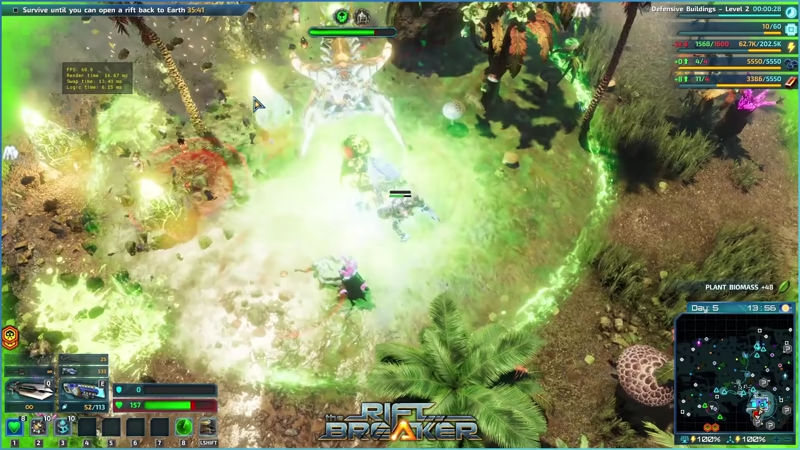
Your help during the beta test allowed us to identify what worked, what didn't, and what was a bit too much to deal with. Thank you!
Open dialogue with the community got us tons of valuable, actionable feedback. We could immediately start improving our initial iteration of Omegas. Thanks to your help, we avoided several overpowered or downright unkillable Omega creatures that would otherwise ruin the experience in the full release of the game. You helped us tweak the values that were not quite right and played a major role in deciding what should be buffed and nerfed. You were happy to play mission after mission, even though we didn’t guarantee that the next wave wouldn’t end your run. Eventually, the Omega creatures reached their current form - one that is in line with our initial idea, and also one that is an exciting addition, not an unpleasant chore. We knew that you knew what you wanted. You knew we could deliver it. This mutual understanding and respect were crucial for this.
Conclusion: Clear communication helps bridge the gap between the developer and the community.
There is no denying that players are the best at finding ways to break the game. Each and every one of us has a different playstyle and ideas. If you multiply the number of players in a session, you also multiply the number of opportunities for something to break. Sometimes players' actions have little to no consequence and don’t prevent them from completing the game as intended. However, in other cases, the game hurts itself in its confusion, leaving players stranded at a point of no return. You can’t always predict when that will happen, but you can do your best to prevent it. Even if you don’t plug all the holes, getting 95% of them might be just enough.
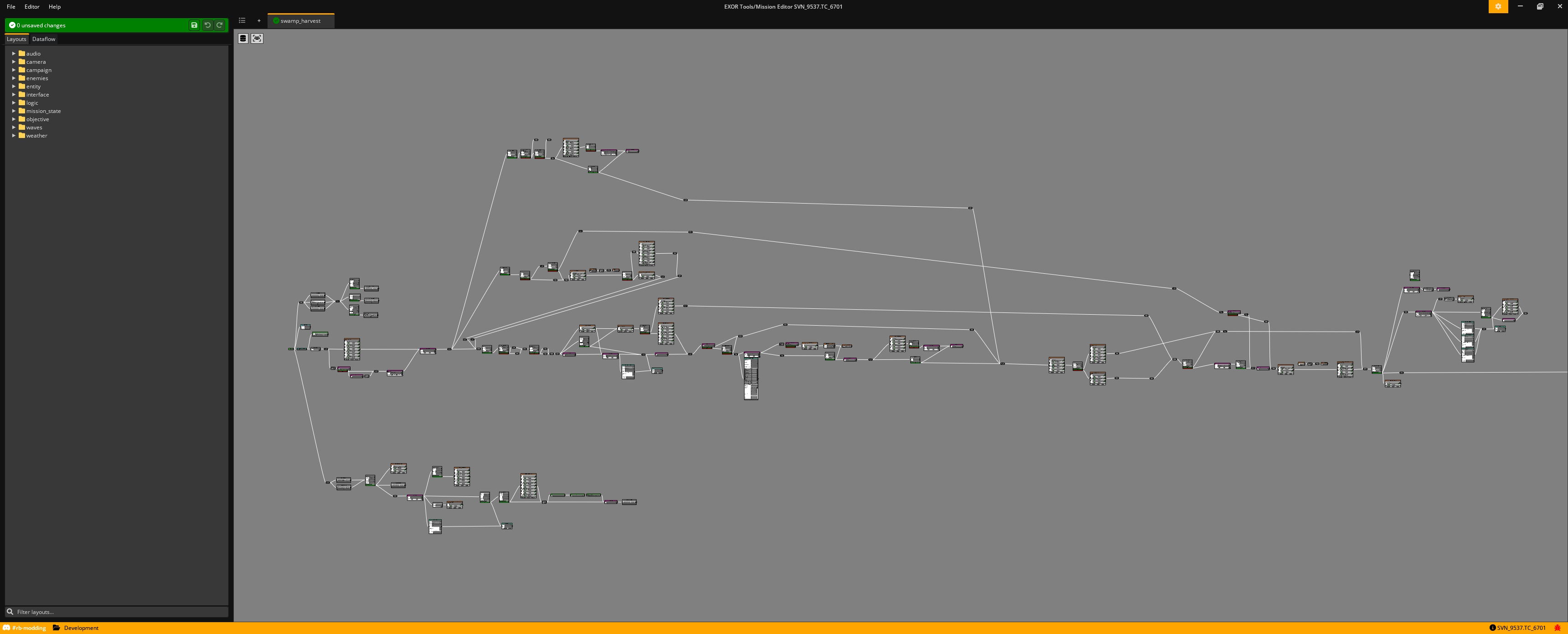
Click to zoom in! This is the mission logic flow diagram for the Swamp Harvest mission. It is as non-linear as it gets - all the events can happen in any order, and it was our designers' job to figure out how to handle all the possibilities. We know it's not the best image, but it's enough to recognize the structure is complex and multi-layered.
An excellent example of a mission where a lot of things can go wrong is the first Poogret encounter in Heart of the Swamp. The mission requires you to find the Garlimonium fruit, find a Poogret, feed the fruit to a Poogret, and then extract the sample from the Poogret's “product.” Sounds simple, but… the map and its creatures live, even if you’re not looking. The behavior of creatures, the map generation algorithm, and the player’s path are all impossible to predict. As a result, any event in our mission sequence can occur in any order. To ensure this mission worked properly, we had to cover more than 10 scenarios, each with its own dialogue. Seriously - try this mission several times, making sure to do things in a slightly different order each time - the results will vary. We are big fans of small details like these, and we know many players appreciate these moments. Solving such a puzzle is incredibly rewarding when everything goes right.

Who would have thought that this beauty was responsible for one of the most complex missions in the entire game?
This might seem like a direct contradiction to lesson number one and another case of “a million custom-made scenarios”. That would be true if we tried to hack it all together by any means necessary. However, it was carefully planned and executed using a systematic approach, which ensures all cases are handled properly, regardless of circumstances. When handling multiple cases is your goal, and not an afterthought, it is much easier to plan and execute on your vision.
Conclusion: Time spent brainstorming is not wasted. Design robust systems that can handle exceptions.
Every once in a while, a community member posts a hot take and an emotionally charged post, voicing their opinion about the game and suggesting what we should do. Such posts generate significant buzz in the community and spark lengthy discussions. We know that the sentiment behind them is nothing but positive - players spend time discussing the game because they care about it. Knowing that and seeing the discussions is a surefire way to grab our attention. However, more often than not, these issues do not represent the views of the majority of the community.
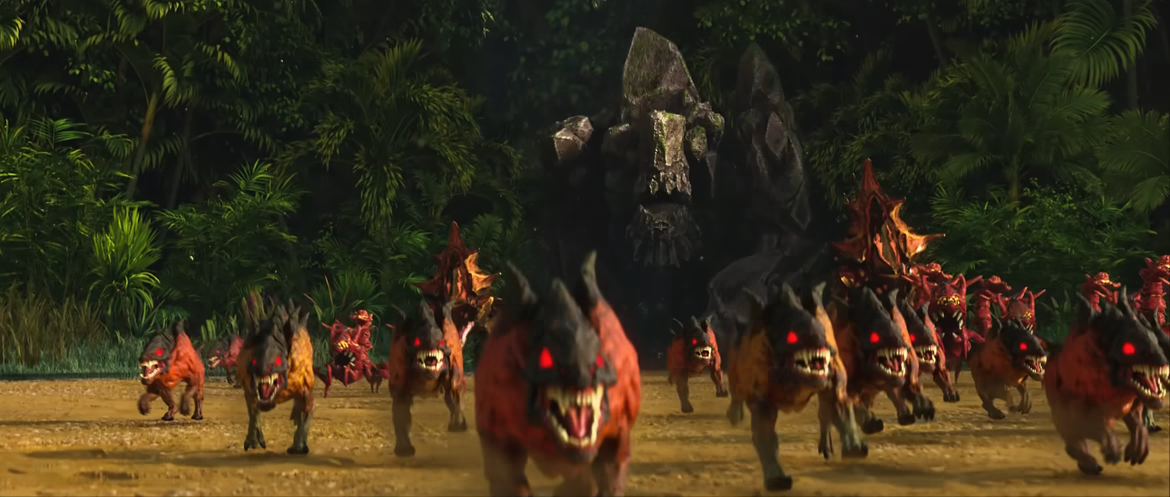
POV: you just announced you will be changing something in the game and open your inbox.
Many players were afraid that the radical changes we introduced with The Riftbreaker 2.0 would destroy the game. Discussions about this always became very emotionally charged, despite our best efforts to explain that there was nothing to fear. However, the topic kept coming up across various channels. Ultimately, we offered to keep the pre-2.0 version live on a legacy branch so it can be accessed regardless of the changes introduced with the 2.0 Update, and we observed the results. As a reminder, our peak concurrent player count for the 2.0 Update was over 18.000. Place your bets on the numbers for the legacy branch.
The answer is [spoiler]7[/spoiler]. No, that’s not how many percent played the legacy branch. That’s the number of individual players. Also, that’s maximum DAILY players, not concurrent. We think it’s safe to say that, despite provoking many heated arguments, leaving things as they were before the 2.0 update was not the most important issue for the community as a whole. This does not mean we regret doing it. It required minimal effort, and if we made at least one person happy, it was worth it.
Conclusion: Emotions are important, but they do not always lead you to the best conclusions. If an issue is critical to the community, sentiment will be almost unanimous.
We want to use this opportunity to promote this video from BoffinBrain. It will allow you to take a look at the world of The Riftbreaker from a fresh perspective - literally! BoffinBrain used the debug "free look" camera to film these scenes, which is not easy at all. After that, they added the sky simulation in post-processing. Very nicely done and worth a watch.
We hope this article has been both valuable and enjoyable. We are back on schedule, so that you can expect more news and previews each week. Unfortunately, we can’t offer you streams for the next couple of weeks due to personal circumstances, but we will be back very, very soon to show off the new Cryo Fields biome in all its glory. If you want to have a chance to beta-test the World Expansion IV update ahead of its official release, sign up for our newsletter here, or join our Discord at https://www.discord.gg/exorstudios. We always post our latest announcements there first.
See you next time!
EXOR Studios