February 2026 will mark eight years since we began work on The Riftbreaker. It has been a massive chunk of our lives, and an exciting journey - one that we’re glad so many of you decided to join. When we started the project, we never expected that we would have the privilege of still developing it so many years later. A lot has changed since the beginning. Many of our ideas didn’t withstand the test of time, while others evolved into the solutions you know from the game today. In this article, we’d like to share a bit about the original vision for The Riftbreaker and how it compares to the game as it is today.
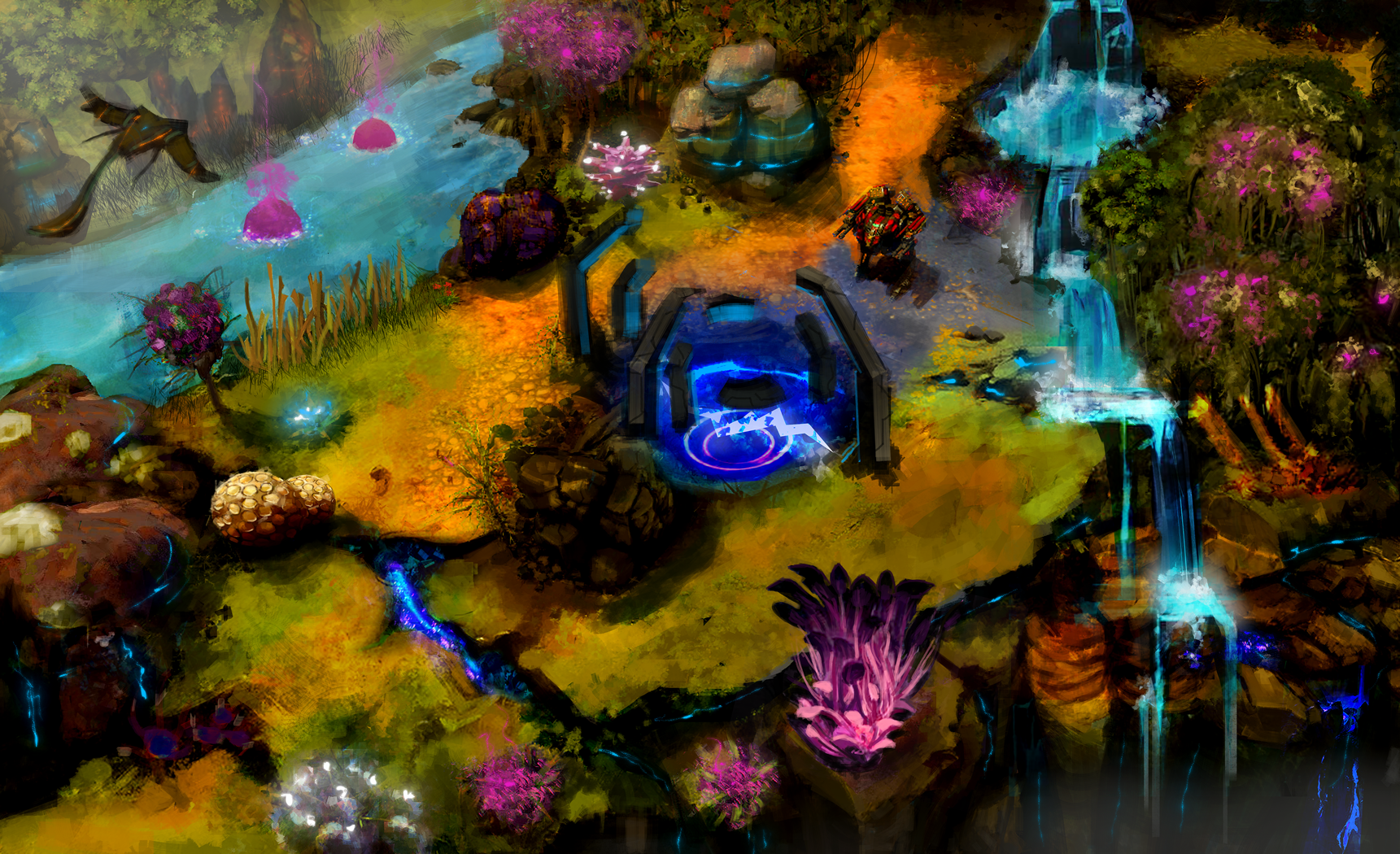
Today's article will feature some never-seen-before pieces of concept art, mock-ups, and trivia. This is the first look at our idea of what the starting biome would look like in The Riftbreaker.
First, a little backstory. After the release of our previous game, X-Morph: Defense, we held an internal “competition” for a new game concept. Each EXOR team member could submit as many game concepts as they wanted. Then we would vote for the one we liked best. Among the 40 entries submitted, only one of them managed to get the approval of the entire team - a “Unique twin stick isometric shooter with survival base building” called Project Pandora. We didn’t have an actual title for it, just a codename. However, another submitted game project did have a cool title - The Riftbreaker. We decided to merge the two - historically, we are REALLY bad at naming things, and decided not to let a half-decent title go to waste.
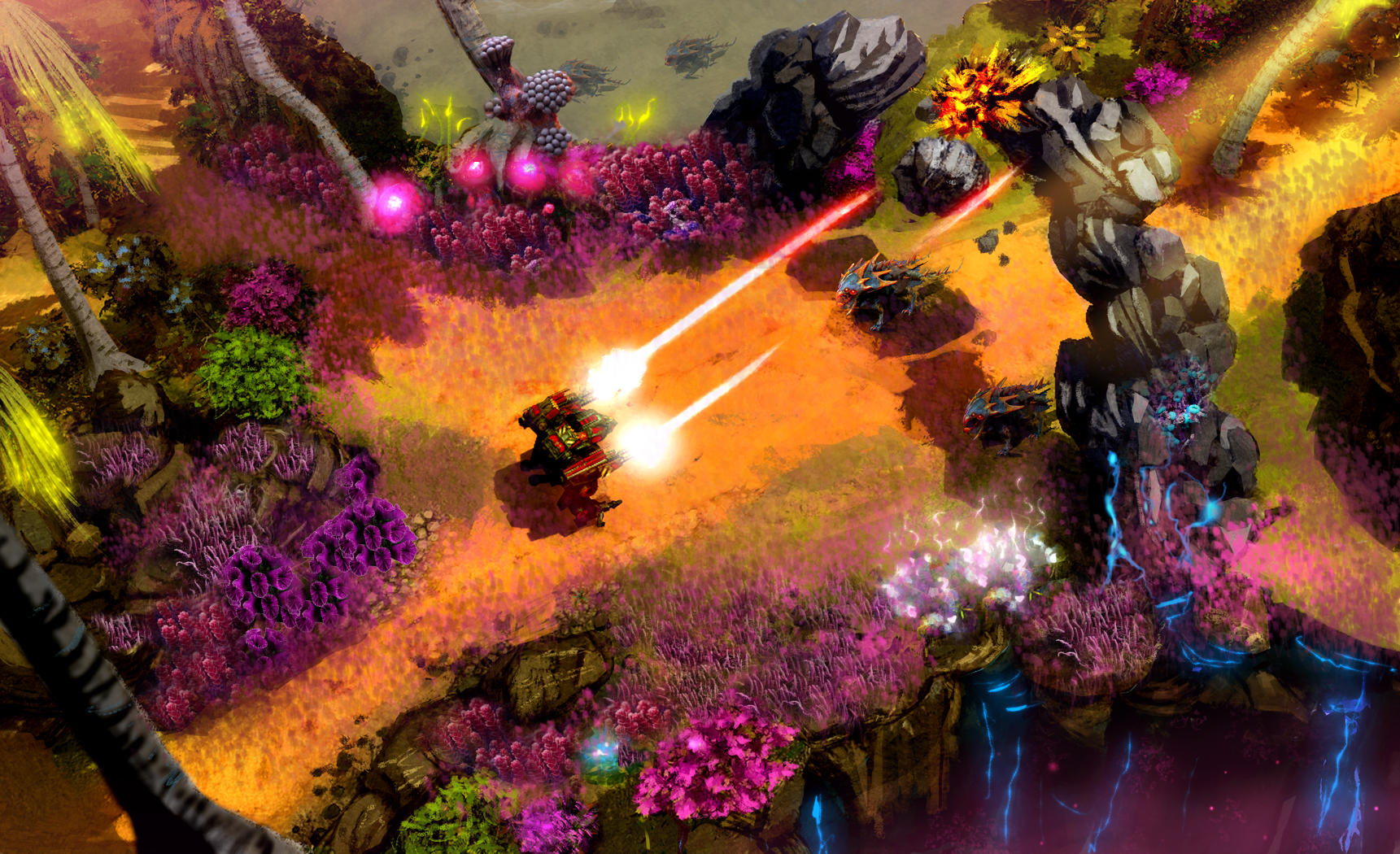
Here's an "action shot" from that era - we re-used the mech model from X-Morph: Defense, and had it open fire at Canoptrix's ancestors. If you take a closer look, it turns out that these creatures can swim!
Project Pandora’s core concepts have stayed mainly intact throughout the development process. The players would travel to an alien, hostile world somewhere in deep space. Their main task was to conquer the planet by building and maintaining a colony. However, we didn’t want the game to be a classic colony sim with a “hand of god” control scheme. Instead, we decided to immerse the player in the game world a little bit more. You would take control of a mech in classic twin-stick fashion, with aiming and movement completely independent. The mech would be the centerpiece of the action, carrying out all construction and maintenance and supporting the colony in combat against hostile aliens. We bet it all sounds really familiar up to this point, but we assure you - there are plenty of differences.
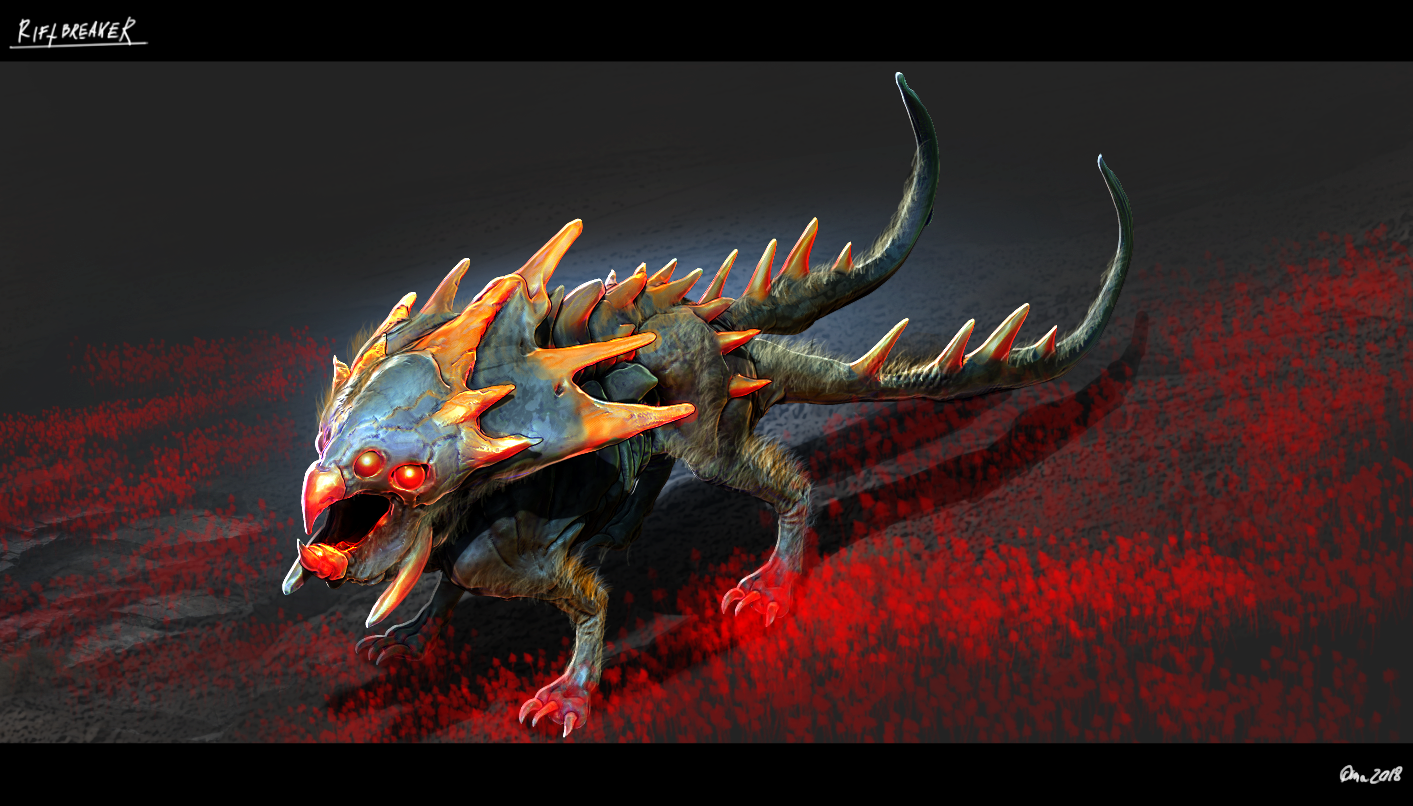
A concept sketch of Felix Nebulosa - one of the creature ideas we had early on. It never made it into the game, because we chose to have Canoptrix as our cannon fodder in the Tropical Zone, and it didn't fit any of our other biomes. Rest easy, chicken lizard.
If you take a look at our artworks, Mr. Riggs is usually depicted with a power blade or another weapon attached to one arm and a drill on the other. That was one of our ideas at the beginning - the mech would only be able to wield weapons in one arm, while the other would handle all sorts of tools: a drill, an energy shield, and various scanners and extractors. This was supposed to emphasize that, in addition to being a weapon of mass destruction, Mr. Riggs is also a multi-purpose colonization machine. We wanted to give you a free choice of tools to equip for a mission. However, when we started playtesting, we realized that manually switching between tools didn’t work out well. There are simply too many things to do during a mission, and context-based switching worked best. Additionally, we didn’t want you to miss out on anything because of not equipping the correct set of tools for the job, so we gave you access to all tools at all times.
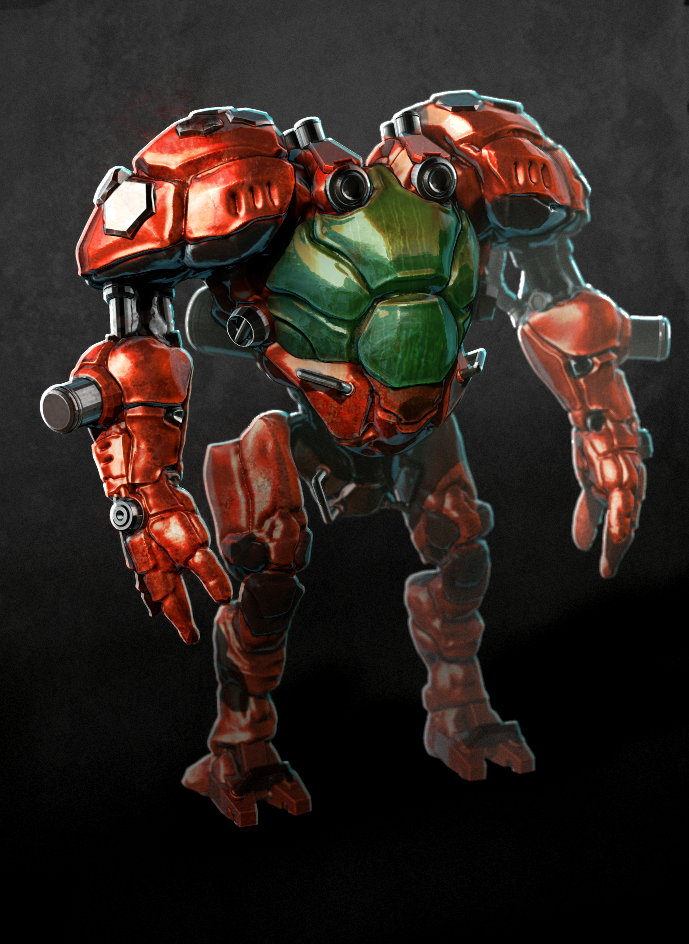
In our earliest concepts, Mr. Riggs looked a little bit different than he does today. Look at his little giant robot hands!
Combat was also a lot different back then. With only one firearm equipped, we wanted to put an extra emphasis on using the energy shield. It was an item that deployed an arched forcefield in front of the mech, blocking all incoming enemy projectiles. That is a pretty powerful effect, so we deemed it would need a significant downside. In the concept phase, we decided that Mr. Riggs wouldn’t be able to shoot with the shield active, following the logic that if enemy projectiles are blocked, it’s only fair to block your own bullets. However, we didn’t want to leave you completely defenseless, so you could carry out melee attacks. In fact, we were so into playing a certain top-down cel-shaded roguelite that we wanted to have a complex melee system, together with combos and power-ups. We quickly figured out that such an approach wouldn’t work versus the hordes we wanted to pit you against. We compromised and allowed you to shoot through the active shield. Still, playtesting showed that nobody wanted to use the shield, as dodging and kiting enemies worked much better.

This is one of the earliest attempts at creating a catchy gameplay GIF. We really wanted to push that shield gameplay.
Additionally, we received feedback that players wanted to wield guns in both arms. As fans of “Souls” of various flavors, both Demon and Dark, this idea had lingered in our heads for a while as well. First, allowed equipping weapons in both hands with independent controls. It was relatively simple for those ones that shoot projectiles, but melee weapons required a little bit of special attention. We prepared unique combo attacks for simultaneous wielding of two melee weapons of the same type. However, problems began when we started mixing and matching various melee types. The number of combinations we would have to support was already high, and given that we had also planned to introduce two-handed wielding, we decided to stop right there. This is how we arrived at the combat system we know today, with dual melee attacks being the only remnant of our plans.

You wouldn't believe it, but this extremely dynamic and exciting combat video is sped up 20%. Imagine what it looked like before!
When it comes to base-building and economy, we wanted to implement mechanics that scale enemy creatures’ aggression based on how eco-friendly your setup is. There were supposed to be two available paths - one that was quicker and cheaper, but would lead to the pollution of the environment, and another one that was more difficult, but also eco-friendly. The premise was that if you went the eco-friendly way, gameplay would be much more peaceful and less combat-focused. Alternatively, if you want to wage war against the entire planet, you might as well use the scorched earth approach and strip-mine everything. Sounds great on paper, but in reality, it would significantly increase the game's complexity. We would essentially have two games in one, and the player could mix gameplay styles in any proportion they wanted. Given that The Riftbreaker was already complex enough, we decided to drop this feature. You can still see the remnants of this in the game - you can either build resource synthesizers for your late-game resource needs, or set up cultivators to grow and harvest plants for you.

Here's a more civilized version of the same scene. We are very happy that you told us shields weren't that great so early in development. This small mistake could have had giant consequences!
Not all of our initial ideas were dropped in the prototyping and pre-alpha phases of development. Since the very first concept, we wanted you to travel around the planet in search of resources and to establish outposts. However, early on, we intended to let the enemies attack the outposts while you were away. We would develop an algorithm to calculate the relative defensive strength of your outpost and then compare that value with the enemy horde's offensive ability. We would give you a time window to return and defend the base if you wanted to. Otherwise, the battle would be resolved automatically. If you won, you’d receive rewards. If you lost, some buildings would be destroyed, and you would have to rebuild them. This is a very complex and controversial feature - we had a lot of internal discussion about how it could end up annoying players having to babysit every outpost. We delayed it several times - so much so that it never made it to release. We wanted to put it back on the table with the 2.0 version, but the feedback we got after announcing it was… strongly apprehensive. Thus, we decided to let it go.
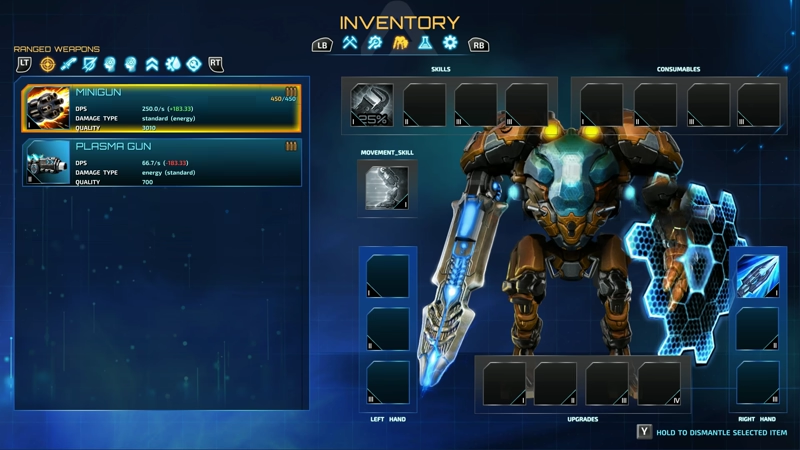
The inventory has also changed a little bit since the start, although the equipment slots remained more-or-less intact. It's also worth noting, that even in this animation from 2018, miniguns look okay. It's very important for miniguns to look at least okay at all times.
These are just a couple of examples of the things that changed in the Riftbreaker from the concept stage to the final, release-worthy shape. We hope it shows that a video game development process is very dynamic and full of unexpected turns. However, not everything changes all the time. In one of the upcoming articles, we will tell you what remained essentially unchanged throughout development. If you don’t want to miss it, sign up for our newsletter here and join our Discord at www.discord.gg/exorstudios. You can always find the latest news there. Be on the lookout for the previews of the free World Expansion IV, including the new Cryo Fields biome - coming really, really soon!
EXOR Studios